
Survey Operations was appointed to undertake a full topographic survey of a 58-hectare golf complex, using advanced UAV LiDAR and photogrammetry to capture accurate, high-density survey data across a varied and operationally sensitive site.
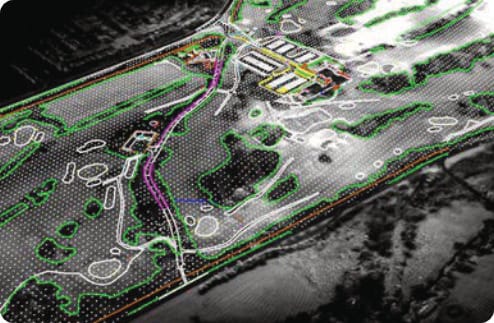
The client required a comprehensive topographic survey, including a grid of levels and a fully georeferenced orthomosaic covering buildings, course features, bunkers, access tracks, irrigation infrastructure and vegetation. The site presented a number of typical challenges for a live golf environment, including undulating ground, areas of vegetation and the need to minimise disruption while maintaining accuracy and safety.
Project Details:
Customer
KOREC
Project
58-hectare golf complex survey
Solution
Wingtra GEN II with LiDAR/camera payloads
Fixed-Wing UAV LiDAR and Photogrammetry
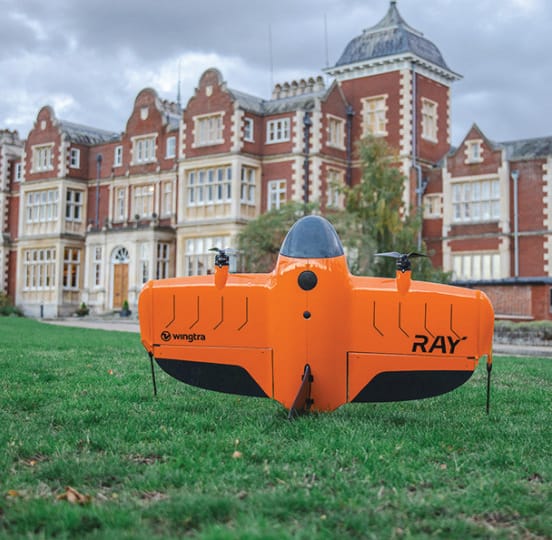
Survey Operations delivered the survey using the Wingtra GEN II, a fixed-wing UAV platform with interchangeable LiDAR and camera payloads. The system was selected to strengthen the company’s aerial survey capability, providing greater efficiency, coverage and data quality compared with traditional rotary drone operations.
The platform was equipped with a Sony RX1R II RGB camera for topographic mapping, orthomosaics and high-accuracy survey work, alongside an oblique Sony a6100 camera for applications such as roof surveys, 3D modelling and detailed site capture. A high-precision LiDAR payload was also added to extend the flexibility of the system.
This approach supports Survey Operations’ wider expertise in UAV surveys, topographical surveys and point cloud surveys.
Efficient Survey Planning and Site Workflow
Before attending site, Survey Operations prepared the flight planning documentation in Google Earth, setting up both LiDAR and photogrammetry missions. The site was divided into two sections to maintain 500m Visual Line of Sight, with the plans transferred directly to the Wingtra controller through the Wingtra App.
On site, ground control points were established and a dynamic risk assessment was completed before flight operations began. This structured workflow allowed the team to work efficiently while maintaining the safety and control required for a live golf complex.
Minimising Disruption on a Live Golf Course
The Wingtra GEN II’s vertical take-off and landing capability allowed the team to set up discreetly without requiring course closures or causing unnecessary disruption to golfers. Its terrain-follow functionality helped maintain consistent altitude over undulating ground, particularly where the course dropped towards a road, improving both safety and data quality.
Low noise levels also helped reduce disturbance across the course, while the modular payload system allowed the team to switch efficiently between LiDAR and camera missions. LiDAR flights took approximately 45 minutes, while photogrammetry flights ran for around 59 minutes of continuous operation.
Accurate Data in Less Time
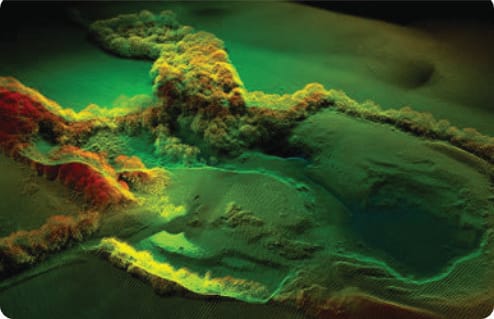
The UAV LiDAR survey delivered clean, high-density data across the course, including areas of heavy vegetation. The three-return LiDAR capability produced consistent accuracies across the site, with vertical accuracy of +/-3 cm RMS. Automatic LiDAR calibration and streamlined processing through the Wingtra LiDAR App also reduced time spent in the field, with automatic trajectory correction, strip alignment and direct point cloud export in LAS/LAZ formats.
Using traditional survey techniques, Survey Operations estimated that the golf course project would have required 10–11 days on site, including additional traditional survey work. With the previous multi-rotor drone, photogrammetry alone would have taken 4–5 days. The Wingtra workflow delivered a faster, more efficient alternative while improving data capture and deliverables.
The Outcome
By combining UAV LiDAR, photogrammetry and a standardised fixed-wing workflow, Survey Operations delivered a high-quality topographic survey and georeferenced orthomosaic while significantly reducing time on site.
The project demonstrated how fixed-wing UAV technology can bring measurable benefits to smaller sites as well as large-scale survey environments. For the client, the result was accurate, comprehensive survey data captured quickly and efficiently, with minimal disruption to day-to-day site activity.
The success of the project also led to further work from the satisfied client.
Project Benefits
- Full topographic survey and georeferenced orthomosaic of a 58-hectare golf complex
- Reduced time on site compared with traditional survey methods
- High-density LiDAR data, including areas of heavy vegetation
- Vertical accuracy of +/-3 cm RMS
- Minimal disruption to golfers and course operations
- Efficient switching between LiDAR and photogrammetry payloads
- Streamlined processing and direct point cloud export
- Improved efficiency, repeatable accuracy and high-quality deliverables